 Scale
ScalePOS systems for Cambodian shops, cafés and restaurants
A till that takes KHQR and cash, prices in USD and gives change in riel, and keeps selling when the connection drops. Supplied, installed and supported by the team that built it, with the owner's phone getting every sale as it happens. Starts at $12.99 a month. Two weeks free, cancel any time. Twelve months for the price of ten. Counter hardware and on-site setup are quoted separately.
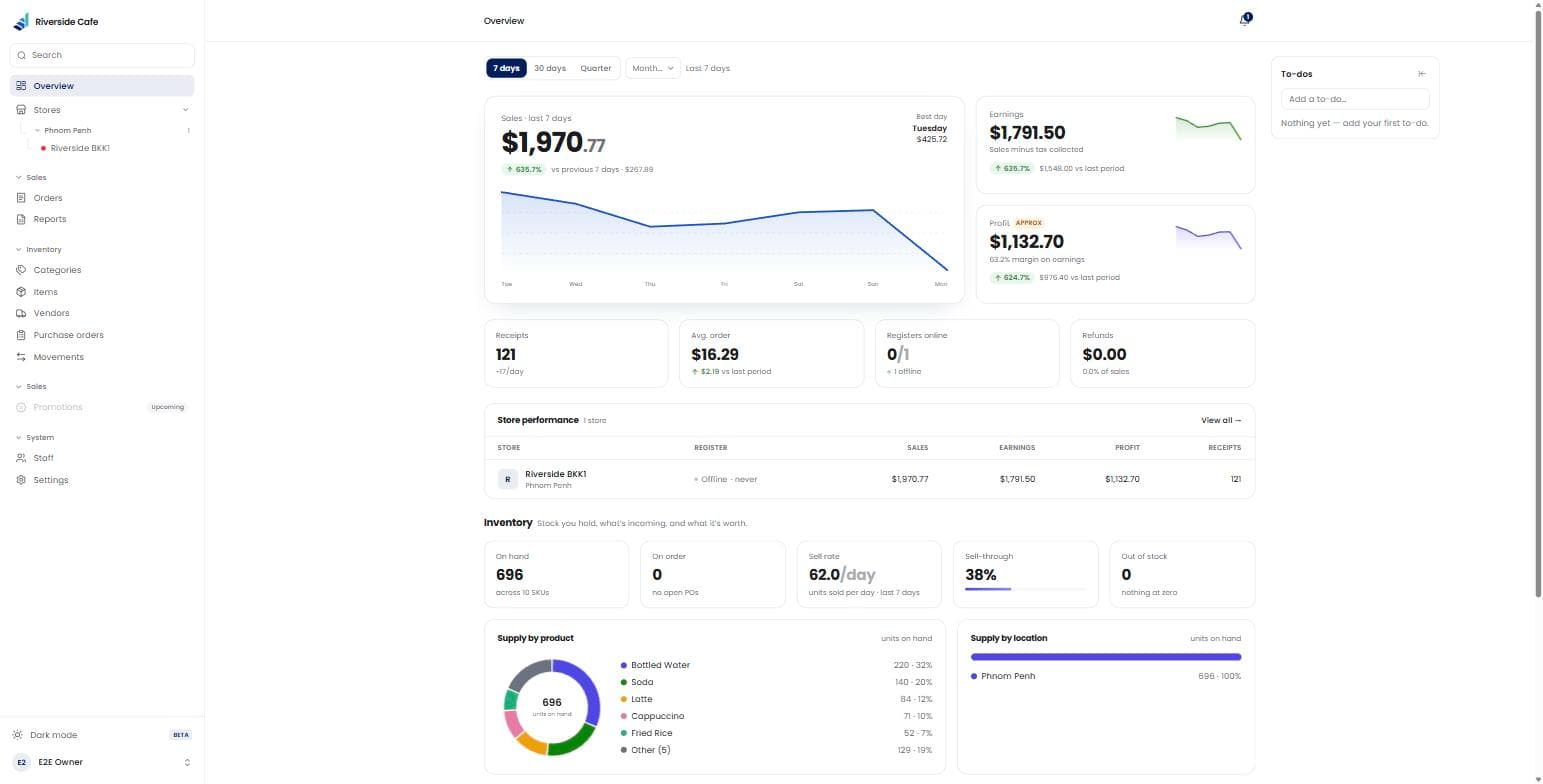
Owner dashboard
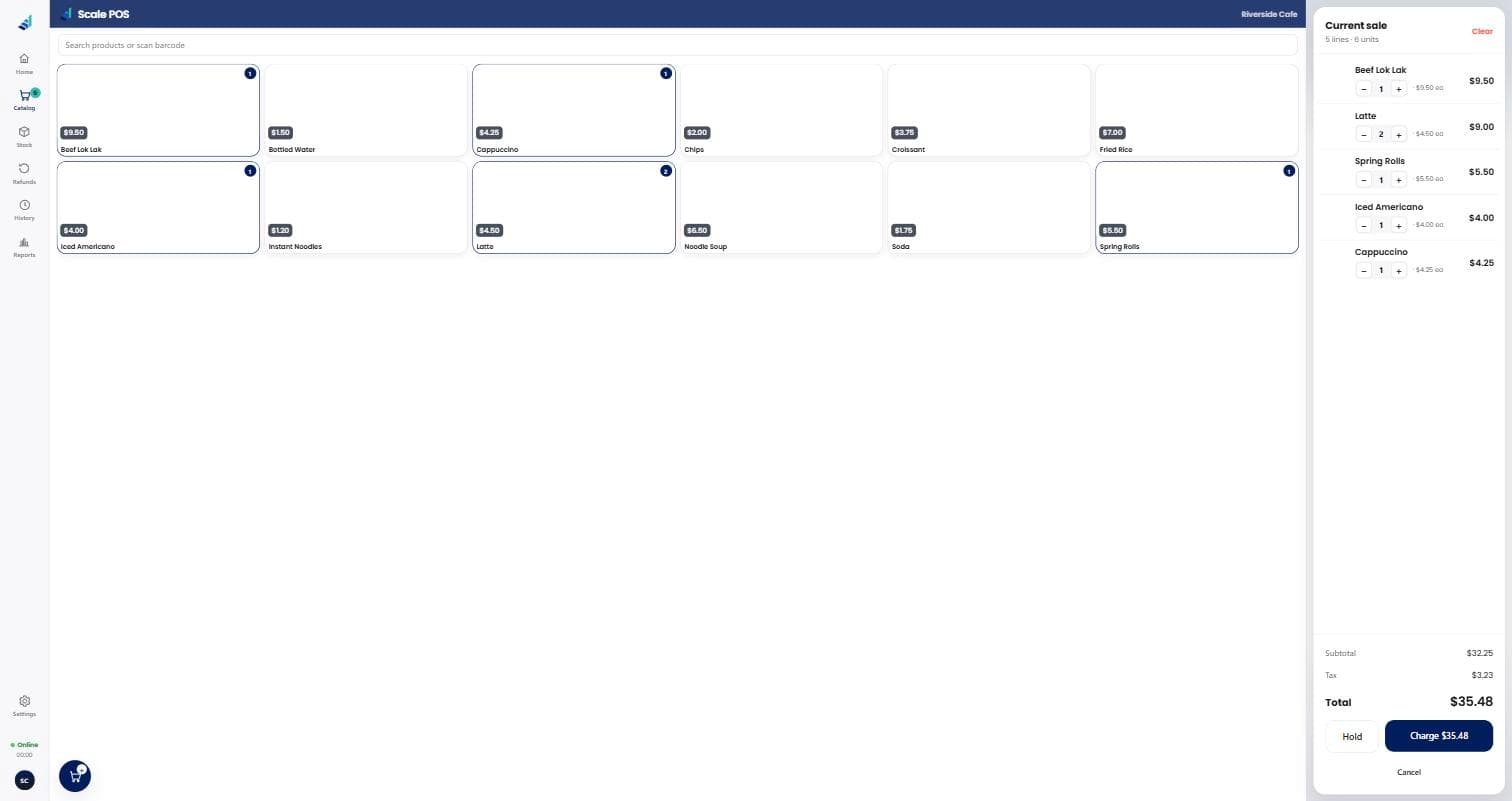
Counter register
What does Scale POS actually cost?
Scale POS starts at $12.99 a month: two weeks free, cancel any time, twelve months for the price of ten. Counter hardware and on-site setup are quoted separately, so that is a floor rather than a full quote, and the plan follows how many counters you run.
The subscription buys the software: the till, the sync behind it, updates as they ship. It is priced by the counter, not the seat, in riel or dollars. The owner's dashboard is included at every tier, Counter included; staff accounts, shifts and permissions arrive with the Shop plan.
Will it handle riel and dollars on the same sale?
Yes, both on the same sale. USD and KHR are held in integer minor units under one rounding rule, applied the same way across sale, refund, tax and report. Ring a $4.50 item, take a 20,000-riel note, and the change is worked out at the till, not on a calculator beside it.
Partial refunds go back by line or by quantity, down the tender rail they arrived on. Shift close declares a float and compares expected against counted per currency, so a drawer long in riel and short in dollars reads as two variances, not one converted total that looks fine.
The mix is moving. Inside Bakong, the national payment system, the riel passed the dollar in 2025: 58.2% of transaction volume, up from 49.3% in 2024 and 18.2% in 2020 (National Bank of Cambodia, Financial Stability Review 2025). How one till handles riel and dollars sets out what that means at a counter.
| Year | KHR share | USD share |
|---|---|---|
| 2020 | 18.2% | 81.8% |
| 2021 | 20.1% | 79.9% |
| 2022 | 21.5% | 78.5% |
| 2023 | 34.2% | 65.8% |
| 2024 | 49.3% | 50.7% |
| 2025 | 58.2% | 41.8% |
What happens when the internet drops?
It keeps selling. The till runs on local storage with the network optional: a sale is written on the device the moment it happens, and a retrying queue catches it up on reconnect. The risk is rarely the grid. It is ten seconds of no signal in the middle of a payment.
Sync runs both ways: sales, payments, stock movements, shifts and staff up; products, categories, registers, tables and accounts down. A price changed in the dashboard waits for an offline handheld, and the sales it rang meanwhile are not stranded on it. A void still asks for a manager PIN with no signal, checked against a local hash and throttled.
No till can speak for a bank, though. KHQR is Bakong's standard — the National Bank of Cambodia's payment system — so the code on screen is one the bank apps already read, but the confirmation still travels back from the issuing bank. That is where acceptance sits: 41,797 card POS machines against roughly 4.5 million KHQR-capable merchant accounts (National Bank of Cambodia, Annual Report 2024). What happens when the line drops mid-payment shows how to test it.
Can I see the till without standing at it?
Yes, on your phone and on a laptop from the first day. Closing a sale writes it once, and both the Telegram alert and the owner's dashboard hang off that same row: muting the bot does not stop the dashboard.
Four things reach a phone, per store and per recipient: every sale, every refund, and the open and close of each shift. Each sale is followed by its receipt as a PDF, and cashiers' names stay off unless you ask for them. Nothing else reaches Telegram.
The dashboard is the other half: sales, items and staff from any laptop, exporting to CSV and XLSX. Run several shops and the Chain plan puts them in one view instead of one login each. The owner dashboard and the live register run on the product page with sample cafe data.
Does it fit a restaurant floor, or only a shop counter?
Both. A restaurant gets numbered tables in named sections with seat counts, tabs that transfer, covers, and a pre-bill matching the floor total exactly. A shop gets a scanner at the till and a stock ledger behind it. Same software, two setups.
- On the floor: tables placed with their own shape and rotation across multiple rooms, so the screen matches the real room.
- In the kitchen: order lines routed to a kitchen or bar printer, each with a fired state, so a runner knows what has gone out.
- From the table: a customer scans the table's QR code, orders from their phone, and the line lands on the till. Payment happens at the counter, split across several payers.
- Behind the counter: barcode scanning, sets so a received case of 24 lands as 24 units and a drink sold takes its components out, per-batch expiry alerts, and purchase orders received against a vendor.

How do you get it running in my shop?
We supply the till, install it on your counter, set the shop up with you, train the people who will use it, and answer the phone afterwards. The software is the subscription; getting it running is the service.
Setup is short by design. Sign in with a phone number and a one-time code, walk a guided setup for business type, stores, owner and schedule, claim each device as a register, then work down a dashboard checklist. A preset for retail, for minimart and pharmacy, or for restaurant sets the defaults.
One thing an accountant will ask: the till is not a tax filing system. The figures for the monthly return, and e-invoicing, come from the accounting or ERP system behind it. How GDT e-VAT filing works covers the obligation and ERP systems for Cambodian businesses covers what carries it.

How does it compare to the other POS systems sold here?
On three questions, not on a feature grid. Ask any vendor what it costs a month, what happens to a sale when the connection drops, and what happens to riel change. The first is often unanswerable from the vendor's own page: most systems sold here publish no price at all, or a price with no billing period.
That is not sinister. Most POS software here sells with hardware, installation and support attached, so the price gets scoped on a call. So we wrote the comparison we could not find: a comparison of the POS systems sold in Cambodia reads ten systems off their own published pages, alphabetically, with our till in the table rather than at the top.
Ask about payments before features, because the money here is moving off cards: 7.0 million payment cards were issued in 2025, down from 12.6 million a year earlier (National Bank of Cambodia, Financial Stability Review 2025). KHQR acceptance sits far wider, roughly 4.5 million merchant accounts against 41,797 card POS machines (National Bank of Cambodia, Annual Report 2024), so a till built card-first is optimising for the rail that is shrinking.
7.0 million payment cards were issued in 2025, down from 12.6 million a year earlier. Source: National Bank of Cambodia, Financial Stability Review 2025.
Questions worth asking any POS vendor
Is the price monthly or yearly?
Monthly. $12.99 a month to start, two weeks free, cancel any time, twelve months for the price of ten. A price with no stated period is not a price.
What happens to a sale if the connection drops mid-payment?
It is written on the device, holds the tender it was taken on, and syncs when the line returns. KHQR is the honest exception: the confirmation travels back from the issuing bank. Ask every vendor where an interrupted QR payment sits meanwhile, and what stops a queued sale being written twice.
Do I need to buy your hardware?
No, and you may not need to buy any. Hardware and on-site setup are quoted against what your counter needs rather than bundled. Receipts print over ESC/POS to USB and network printers, so a printer you already own often works, and a packaged Windows build exists if you prefer a computer.
Can more than one shop run on one account?
Yes, and more than one business. Staff and registers are scoped per store, and you switch between them in the dashboard. The Chain plan turns that into one view with reporting across every store, and several separate businesses can sit under one login with a combined view.
Who can void a sale?
Whoever holds the manager PIN, enforced in the data rather than the interface. Offline the check falls back to a local hash with attempt throttling, so going offline is not a way around it. From the Shop plan up, staff sign in with their own PINs, separate from the owner login.
Do I own my data?
Sales and tax reports export to CSV and XLSX from the dashboard whenever you want them, with no support ticket, so a lapsed subscription never locks up your trading history. The source code is a different promise: it belongs to a custom build, not to this one.