 Scale
ScaleWhat happens to your POS when the connection drops
Not the power. The signal. What a half-finished KHQR payment does to your sales record, and what to test before you buy.
- The risk in Cambodia is the mobile signal, not the grid: services average 0.7 outages a month and 99.2% of the country has electricity access.
- A cloud-only till stops trading the moment the connection does. An offline-first till queues the sale locally and reconciles on reconnect.
- The question that separates them is what happens to a KHQR payment interrupted mid-transaction.
- Test it in the demo: put the device in aeroplane mode, ring three sales, reconnect, and count.
Is the power really the problem?
No, not for a shop. Almost every offline-first pitch in this category is built on the fear of a blackout, and in Cambodia the numbers do not carry it. The World Bank's 2023 Enterprise Survey put services firms at 0.7 outages a month and found only 10.5% of retailers naming electricity as a major constraint. Electricity access reached 99.2%. The grid is a real problem for a garment factory. It is not what stops a till.
| Sector | Firms experiencing outages | Outages per month | Calls electricity a major constraint |
|---|---|---|---|
| All firms | 42.8% | 0.9 | 11.6% |
| Manufacturing | 55.7% | 1.4 | 21.3% |
| Garments | 82.9% | 2.3 | 22% |
| Services | 38.5% | 0.7 | 8.3% |
| Retail | Not reported | Not reported | 10.5% |
The table sorts itself by who owns a machine. 82.9% of garment factories experience outages, against 38.5% of services firms, because a production line that stops is expensive in a way a counter is not. The blackout framing is borrowed from that world. Stand behind a counter in Phnom Penh and the lights mostly stay on. What goes is the signal.
So what is the problem?
The connection between the till and everything behind it. Cambodia has more phone connections than people, 21.7 million of them, around 121% of the population. Internet penetration stood at 67.3% in October 2025. Nearly everyone carries a phone; roughly a third of the country is not online. That gap is what a demo over the vendor's office fibre never shows you.
And the till is usually not on mobile data anyway. It is on the shop's own wifi: a consumer router shared with the CCTV, the music and the office laptop, on a line sold as a home connection. An afternoon with no internet is obvious, and staff work around obvious. The ten-second hole is not. The router reboots, the ISP re-routes, a handheld walks two rooms from the access point mid-payment, and all anyone sees is a spinner. Nobody writes it down.
So the useful question is not whether a till works with no internet. It is what it does to a sale that was halfway through when the line went.
What actually breaks when a sale is interrupted?
Not the sale. The record of it. Whether the customer paid is settled between them, the drawer and the bank. What the interruption damages is what your system believes happened, and there are four ways that goes wrong. Each is quiet at the counter and loud at month end.
- The sale that was never written. The till sent it, the network ate it, nothing came back. Stock still shows the item on the shelf, the day is short by one basket, and nobody is looking.
- The sale that was written twice. The till heard nothing back and sent again, and the first attempt had landed after all. The day is long by one basket, the item has left stock twice, and the fix is a manual correction somebody has to spot first.
- The KHQR payment the bank recorded and the till did not. The customer's phone shows a completed transfer, the confirmation never travelled back, and the sale sits unpaid or does not sit anywhere. This one arrives as an argument at the counter, not as a line in a report.
- The shift that closes against a total the drawer disagrees with. Any of the three above surfaces here first, as a variance with no story attached. A variance nobody can explain is indistinguishable from theft.
The fourth is why the first three matter. A shop can absorb a lost sale. What it cannot absorb is a shift report it has stopped believing: once a variance is normal it stops being a signal, and a real one walks straight past you.
What does offline-first actually mean?
It means the till is the system of record while the line is down, rather than a screen waiting for one. Scale POS runs entirely on local storage with the network optional: the sale is written on the device the moment it happens, and a retrying queue catches the device up when it reconnects. Nothing in the checkout path waits on a round trip.
The sync runs both ways, and which way each thing travels is worth knowing. Sales, payments, stock movements, shifts and staff go up. Products, categories, registers, tables and accounts come down. So a price changed in the dashboard while a handheld is offline is waiting for that device when it comes back, and the sales it rang meanwhile are not trapped on it.
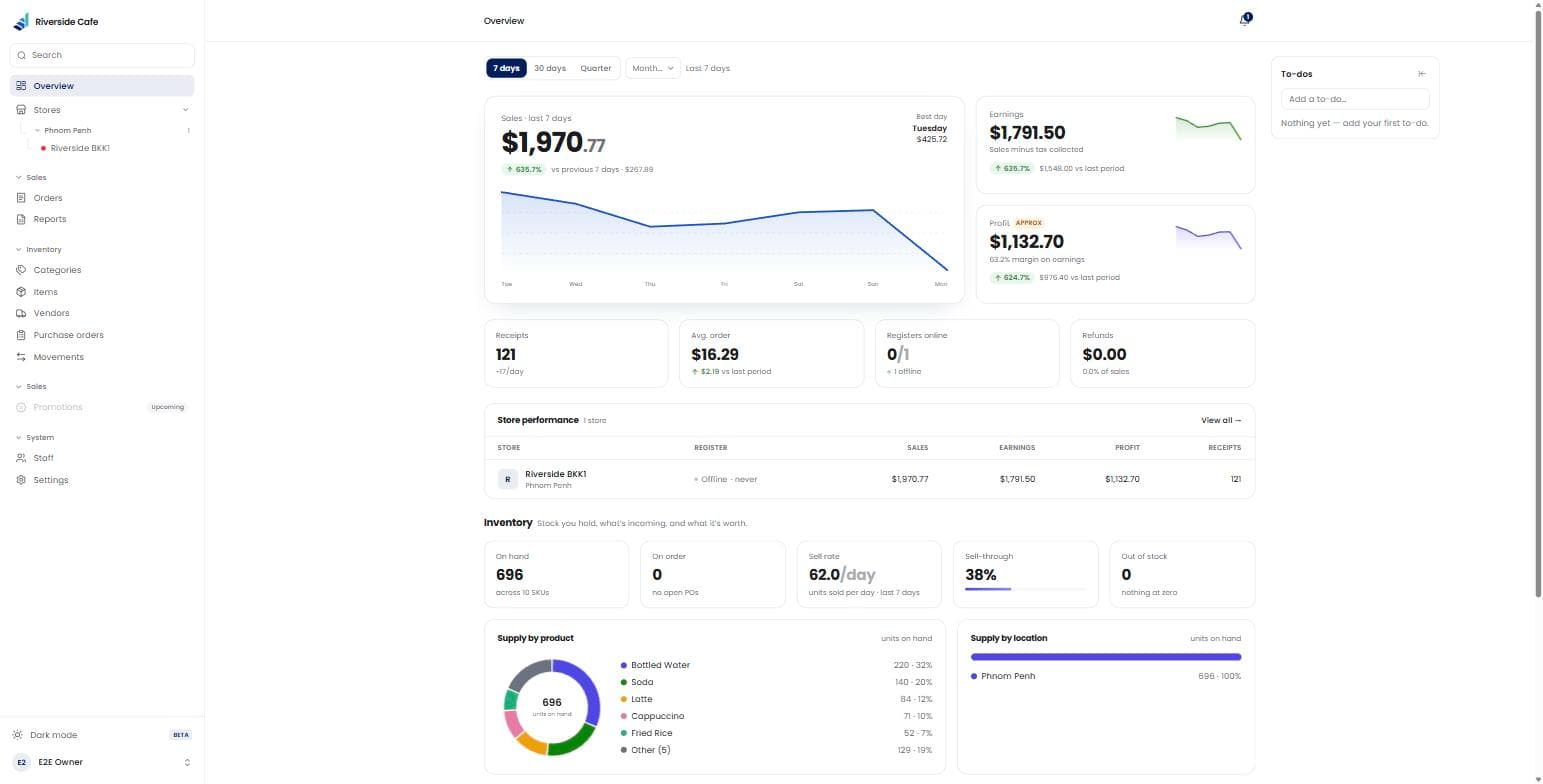
Control has to survive the same conditions, or offline mode becomes a loophole. Manager authorisation on a void asks for a manager PIN; with no signal it falls back to verifying against a local hash, with attempt throttling on top. A void still needs a manager when the line is down.
What offline-first cannot do is speak for a bank. A KHQR code is issued by the bank behind the merchant account, and confirmation that the money moved has to travel back from it; no till, ours included, can produce that with no path to the network. The guarantee worth asking for is narrower and more useful: the sale survives, holds the tender it was taken on, and reconciles against the bank's own record when the line returns. What else a till has to cover here is set out on the POS page for Cambodian counters.
How do you test it before you buy?
Ask for a demo device and break it yourself, before any money changes hands. A vendor who has solved this will be happy to watch; one who has not will want to talk about something else, and that answer is worth as much as the test.
- Put the device in aeroplane mode. Not the shop wifi switched off. The device itself, so nothing quietly falls back to mobile data.
- Ring three sales, then refund one of them. Use more than one payment method if the till still offers them.
- Print a receipt. If the printer is on the network rather than a cable, this is where a lot of tills stop.
- Turn the connection back on and watch. The device should tell you it is catching up rather than leave you guessing.
- Open the dashboard and count. Exactly three sales and one refund, each appearing once. Two of anything is the retry problem, found on a demo instead of on a Saturday.
- Close the shift and read the drawer figure. Expected and counted should account for every transaction you rang, refund included.
Then ask what happens to a KHQR payment specifically. The QR is issued by a bank and the confirmation has to travel back, so "it works offline" is not an answer. What you want to hear is where that payment sits in the meantime, and how it is matched to the bank's record afterwards.
Frequently asked questions
- Can I still take KHQR with no internet?
- Partly, and the distinction is the whole answer. The QR is issued by the bank behind your merchant account, and confirmation that the transfer went through has to travel back from that bank. No point-of-sale software can produce that with no path to the network. What an offline-first till guarantees is narrower: the sale is written locally, holds the tender it was taken on, and reconciles against your bank record once the connection returns. A vendor who claims more than that is describing something else.
- If a till was offline all afternoon, are my dashboard numbers wrong?
- They are incomplete until that device syncs, which is a different problem from being wrong. Sales, payments, stock movements, shifts and staff travel up from the device, so the afternoon appears once the till reconnects. What matters is telling the two states apart, and the dashboard has to say which one you are looking at. Check that in the demo.
- What stops a sale being counted twice when the device reconnects?
- The sale has to carry an identity the server recognises on a second attempt, so a retry updates the existing record instead of writing another one. A queue that retries is not, by itself, a promise that it will not duplicate; those are two separate pieces of engineering. Put the question to any vendor you are considering, this one included, then verify it with step five of the aeroplane-mode test above.
- My shop has good wifi. Do I need this at all?
- The failure this protects against is rarely an afternoon with no internet. It is ten seconds in the middle of a payment, on a consumer router shared with the CCTV and the music, and that happens on good wifi too. When you never need it, offline-first costs nothing: the till behaves identically. When you do, it is one interrupted sale at a busy moment.
Where to go next
Offline on the road rather than at the counter is the field rep's version of this problem, and it is solved differently. What a POS system costs and covers in Cambodia sets out the till, the hardware and the support around it. Riel and dollars on one till covers the other thing a Cambodian counter quietly gets wrong. Ten POS systems compared records which vendors state an offline behaviour at all, and which leave the column blank. The Scale POS product page shows the register and the owner's dashboard as they actually run.